

AN IMPORTANT FIRST STEP
Naotaka Ikebe is optimistic about the future of careers education if we use AI in the right way.
AI and careers uncertainty
As in almost every sphere of life, AI seems to be creating new types of uncertainty in the world of education. We seem to be living through a period of unbridled change and the temptation is to set off down one road or another before we are really sure of its destination. This problem, I think, has a particular urgency in the sphere of careers education as the professional pathways to which we have drawn attention of young people in the past seem to be changing beyond recognition – or even disappearing altogether.
There is a general feeling of disquiet felt by advisors. More seriously, young people are worried about their future.
Professional dialogue and learning
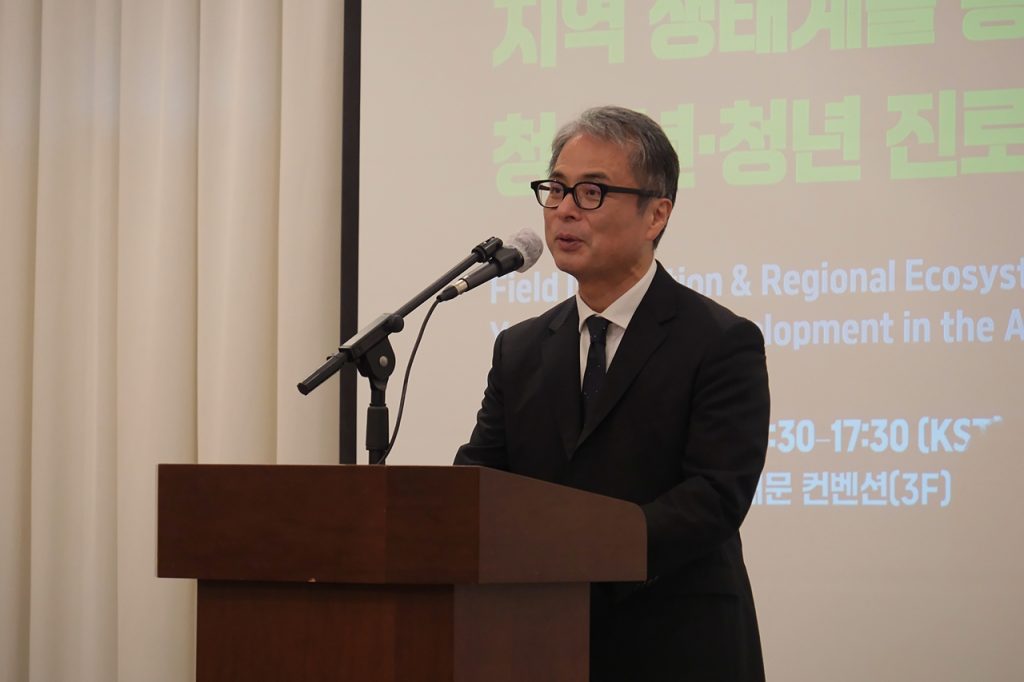
Opportunities to discuss where we are and the direction we might take as careers professionals have therefore never been more welcome. The need is universal – we certainly feel it in Japan and from my perspective it came as opportune to attend an important debate that took place in Seoul this August, wonderfully organised by Korea’s National Youth Policy Institute (NYPI). The area for our learning was summed up in the symposium’s title: Field Innovation & Regional Ecosystems for Youth Career Development in the AI Transition Era.
It was a great honour to be invited to contribute, but the highlight was having the opportunity to learn from colleagues representing the Japanese Society for the Study of Career Education (JSSCE) and the Korean Society for the Study of Career Education (KSSCE) who gave voice to what, I think, we are all experiencing. Everyone brought a distinct perspective from their research and practice, providing the opportunity for a dialogue which was beyond useful and for which I was personally very grateful.
A partnership worth building
In Korea and Japan, we are confronting the same wave of technological innovation at roughly the same time and I was struck by how many similar challenges our two countries have faced simultaneously— but I was equally struck by how much we still have to learn from each other.
There was one idea that I think will become central to our responsibilities in both countries as careers educators. We were honoured to welcome Dr. Jaana Kettunen, President of the International Association for Educational and Vocational Guidance (IAEVG), as the keynote speaker.
One of her closing observations has stayed with me when she argued:
“AI may produce a draft of a future. [Professional] Guidance helps a person author one. That is what remains unmistakably human.”
I can think of no better way to express what I have come to believe through my own research and fieldwork. There is something special in helping young people author their own future – and this facilitation, at its best, is human.
Findings from the field
In this context and amid the rapid diffusion of generative AI, it is worth reflecting on the current state of careers guidance in Japan. Our employment-transition system rests on two distinctive pillars. One is shinsotsu ikkatsu saiyō, the practice of recruiting new graduates in large numbers through a relatively standardised, simultaneous recruitment cycle. The other is “Hello Work”, the nationwide network of public employment offices. These institutions have contributed to a relatively stable school-to-work transition for generations. Both now face growing difficulties in responding to the increasingly diverse needs, circumstances, and aspirations of today’s young people.
This was well illustrated during a fieldwork experience I had at a Hello Work office in Tokyo that serves recent graduates. Here the Director offered a striking perspective. If there are one hundred students and one hundred companies, he suggested, ‘human navigators’ may still be the most efficient way to make the necessary connections to give good careers advice. But when the numbers rise to one thousand—or ten thousand—generative AI can process and narrow the enormous volume of information far more efficiently. This, in turn, can free human professionals to devote their time to deeper, more individualised support. Is this, I thought, a possible way forward?
One step at a time
Like others, he is worried. In some high schools, he said, career guidance is not functioning adequately, leaving a growing number of young people to enter society with little or no meaningful support.
I think going forward will need to be taken one step at a time, but as the Director at the Hello Work office implied, they will have to be the right steps. Recently at a careers evening (part-time programme) held at Shonan High School I learned of a digital job-listing platform introduced there in 2025, which had unexpectedly increased parental involvement which, according to Mr. Taguchi, the teacher with whom I spoke, had improved the quality of career counselling.
His observations went to the heart of the issue: perhaps AI can help make sense of the enormous field of available information. What, he suggested, remains uniquely important, however, is the judgement of a trusted adult — who has the experience what to share, what not to share, and why a particular possibility might matter to a particular young person. A trusted adult, I thought, just like Mr. Taguchi.

Closing the counselling gap
I think we are now feeling our way to discovering the kind of realistic and constructive role AI might play in the field of careers education. It will not – and should not replace the work that grows from the establishment of trusting human relationships, but it can be used to remove some of the more administrative burdens that attend the work of all educators. To paraphrase Prof. Jaana’s words, the human work needed is to read the AI draft with the student, who then goes on to author their own future. As the principal of one high school told me:
“Even in the age of generative AI, I want to believe that, in the end, a single word from a trusted teacher can enrich a student’s life story.”
There’s that word ‘trust’ again.
Long may this be so, and long may the professional relationships established in Seoul earlier this year be used in the service of young people. Right now, our students have never needed us more.
Naotaka Ikebe is Visiting Professor, at the Graduate School of Education, Waseda University and part-time Lecturer, Seikei University, Tokyo, Japan
1-6-1 Nishi-Waseda, Shinjuku-ku, Tokyo 169-8050, Japan
FEATURE IMAGE: metamorworks on iStock
Support Images: Courtesy of the National Youth Policy Institute (NYPI), Republic of Korea. The opening address given by Professor Teruyuki Fujita of the University of Tsukuba, President of the Japanese Society for the Study of Career Education (JSSCE). and Getty Images For Unsplash+
