

ASK THE STUDENTS
Worried that the quality of student homework was declining, teachers at St. John’s International School in Brussels asked them what homework they thought was worth doing. Emily Rankin reports on what happened next.
Negative patterns
Homework: The bane of students’ existence, or a meaningful chance to consolidate learning? Our school has attempted to tip the scales toward the latter.
Last year, our Middle and High School (MHS) divisions were seeing a couple of patterns with regards to homework:
- At times, teachers felt like Sisyphus dealing with AI infractions; a fair amount of effort was being spent following up on suspected AI-produced work
- We had some concerns from parents and students about lack of consistency around homework expectations
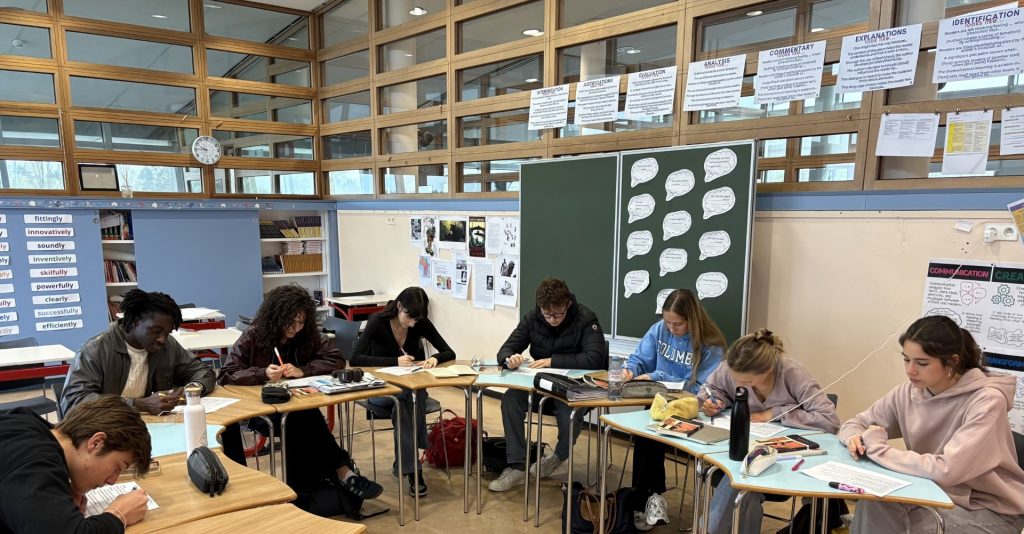
Yes, we already had an Assessment Policy, but it didn’t directly address either of these issues – so I brought them to our MHS Subject Leaders. We discussed what values we wanted to uphold in our assigning of homework and reviewed the EEF toolkit on homework, which states, “The quality of the task set appears to be more important than the quantity of work required from the pupil.” Then we wrote suggested homework ‘tenets’ or principles on post-it notes and grouped them on the wall.
Student survey
From these, we agreed we would develop an anonymous Grades 6-12 student survey; after drafting and revising, our questions were:
- In general, how do you feel about the homework you are assigned?
(Strongly disagree, Disagree, Agree, Strongly Agree)
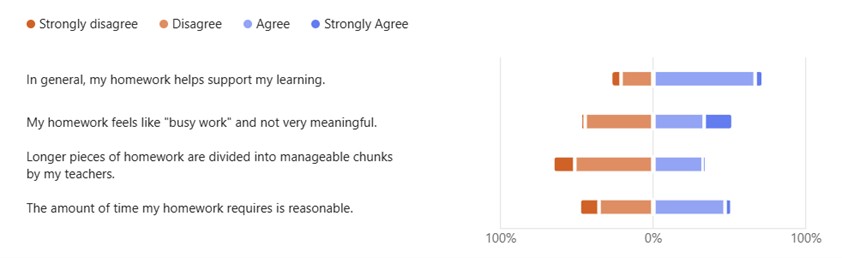
- In general, my homework supports my learning
- My homework feels like “busy work” and not very meaningful
- Longer pieces of homework are divided into manageable chunks by my teachers
- The amount of time my homework requires is reasonable
- Would you like to comment on any of the above? (Short answer)
- On average, how much time do you spend on homework on school nights?
(Not much, Around 30 minutes, Around an hour, Around 90 minutes, Around 2 hours, More than 2 hours)
- Do you think your homework should be graded?
(Yes – grades are important to me; No – homework is meant to help me learn, not grade me; It depends on the assignment)
- What sorts of assignments work best for you? (Short answer)
- Have you utilised AI to complete homework? (Yes or No)
Outcomes
The student feedback revealed a few things. I was surprised to find that only 3% of students absolutely wanted their homework graded. 48% said it depended on the assignment, and 49% felt grading homework wasn’t necessary, though a number wrote that they wanted feedback or reviewing of answers in class.
Also, while our grades 9-12 reported similar estimated times they were spending on homework, grades 6-8 (Middle School) were wildly different, calling into question student perception of how much time they really were investing in it. 66% of all Grade 6-12 students admitted to having used AI to complete homework.
The Likert Scale questions scored like this:
Many students wrote comments related to clarity around what was being set; they wanted clear instructions and the tasks posted on ManageBac well in advance of the due date. Although they hadn’t been asked to do so, a number identified subjects in which they felt they were doing too much or meaningless homework.
A wide range of answers regarding preferred homework were given, there was a definite pattern of responses like “some mini exercises from what we have covered in class”; “short revision homework”; and “multiple short exercises that are similar to what we studied in class that day.”
Changes and impact
Armed with this student feedback, the initial concerns and research, we developed this simple set of evidence-based Homework Tenets specific to our context. So far, the outcome has been positive; our ManageBac platform is being used clearly and purposefully for homework setting, we are spending much less time dealing with suspected unethical AI use, and MHS parent concerns are almost non-existent. Moreover, fewer concerns about incomplete homework are being reported by teachers via iSAMS – an unintended win.
In this pdf by Tom Sherrington and Sara Stafford for The Chartered College of Teaching, they suggest that,
“Homework can be a powerful means of supporting student learning and study habits, provided it is designed appropriately.”
Moving forward, I would like to see us develop a booklet of high-impact homework design examples, largely grounded in retrieval practice, and I would like to run the survey again during the Summer term for a quantitative comparison of results.

Emily Rankin is Deputy Head / Head of Academics at St. John’s International School, Belgium
Further reading
“Guest Blog: Retrieval Practice – A Common Good or Just Commonplace?” Education Endowment Foundation, 22 July 2021, https://educationendowmentfoundation.org.uk/news/guest-blog-retrieval-practice-a-common-good-or-just-commonplace.
Education Endowment Foundation. Homework. Teaching and Learning Toolkit, Education Endowment Foundation, Aug. 2021, https://educationendowmentfoundation.org.uk/education-evidence/teaching-learning-toolkit/homework.
Sherrington, Tom, and Sara Stafford. Homework. Chartered College of Teaching, 2021, https://my.chartered.college/wp-content/uploads/2021/10/Homework_Sherrington.pdf.
FEATURE IMAGE: by Gerd Altmann from Pixabay
Support Image: With thanks to Emily – G12 IBDP class
