

WHAT DO GREAT SCHOOLS HAVE IN COMMON?
Adam Seldon travelled the world for a year visiting schools in a quest to identify what made some of them ‘great’.
The journey
Between 2024 and 2025, I visited over 80 schools in 30 countries, across six continents, to understand what makes a great school. I visited primary and secondary schools, state, private and international schools. I sought out a variety of cultures, contexts and approaches. I observed schools with English as the language of instruction, and a range of other languages. I found that however different they were, the schools that impressed me as ‘great’ had certain things in common.

Great schools ask enduring, rather than transient questions
Schools often embrace the latest trends, especially in a time of rapidly evolving technology. However, I found myself drawn to those that showed they were thinking about the enduring questions of education, those which confronted the fundamental challenges: how can I lead a fulfilling life? How can I find purpose in what I do? How can I be a responsible member of society? Hitting standardised benchmarks or external frameworks may be necessary, but is seldom sufficient. The schools I was drawn to seemed to be ahead of policymakers by allocating time to think about research and understand the complex beast that is education.
A school I visited in a poorer part of outer Buenos Aires developed an in-house, social-emotional development curriculum simply because nothing else out there was good enough and because they believed their students needed it. Schools with a capacious outlook seemed more likely to ‘break the mould’ imposed by daily pressures and become a beacon within their system. They nurture an ambitious education that prepares the child for whatever the future might look like.

They are places of deep learning for everyone
Schools can become places of unthinking routine when they should be places of learning for students and teachers. Staff development often focuses on teaching and learning techniques or subject knowledge, but is this where they should be investing their time? At some schools I visited, I found an intellectual culture that thought deeply about education and how this related to their own context. At an elementary school in Texas, leaders challenged the traditional teacher role in the classroom and rethought what children could do. Their bold approach was supported by a staff ‘den’, which was a room full of books, not just on education, but also psychology or anthropology. ‘We are constantly reading and learning,’ the principal told me.
Staff believed they were engaged in something beyond their classroom practice, developing motivation. I discovered that this kind of culture was almost always driven from the top, where leaders thought about, and were thoughtful about, education.
Great schools develop a culture
The philosopher John Locke believed the mind to be a blank slate that can be shaped almost entirely by its environment. Travelling the world, I was often struck in schools by how malleable the students were, and how they absorb and express the codes, lingo and values of their school with passion. After twenty years as a New Zealand Principal, one school leader told me, ‘You can pick up the culture and soul of a school in a heartbeat.’
Strong cultures are built intentionally, rather than left to chance, or left stagnant on a display board. Irrespective of the national system in which they operate, great schools had the space in which to leave a distinctive imprint on their students.

They are holistically rigorous
Rigour was a common feature across the schools I visited. However, in schools that moved me, this extended beyond the rigour of traditional academic disciplines and more towards moral, spiritual and emotional development, areas in danger of lacking the coherence of subject disciplines. Schools often claim to provide a ‘holistic’ education but struggle to articulate what this means in practice.
The best holistic education I observed was not a fluffy add-on. It was be an essential foundation for a flourishing life. A rigorous approach can transform the superficial into the meaningful. It comes down to the intentionality behind what the school is doing and why they do it. One girls’ school in Sydney prioritised well-being (without compromising academics) by setting aside the time, energy and structure students deserved.

They celebrate a range of strengths
Of course, academic success matters, but in really good schools it does not preclude valuing other student activities. In the best schools, academic achievement is reinforced by broader educational fulfilment, giving students greater chances to build self-worth. In one school in China, they proved their claim that ‘students work as hard at the arts as academics’. Success in extracurriculars can create a positive chain reaction, strengthening motivation and a student’s sense of connection to their school.

Mission and narrative
Every school identity is unique, but not every school identity has power. The staff and students most animated about their school had a clear, defined purpose, mission and vision.
One school I visited in the USA had a mission statement of ‘To and through college’. It wasn’t enough to get the students to university. Their school needed to cultivate the inner resilience and motivation to help them see it through. Institutions have their own storytelling capacities that bind people to their institution. This sense of teamwork and connection to each other and the school generates a level of commitment from staff and students that creates something special.
Beyond good
Good schools inevitably achieve success for their students by helping them secure good qualifications and next stage entry. The challenge of getting to that point should never be taken for granted. However, great schools have the intent and ambition that lead to flourishing students and wider school communities.

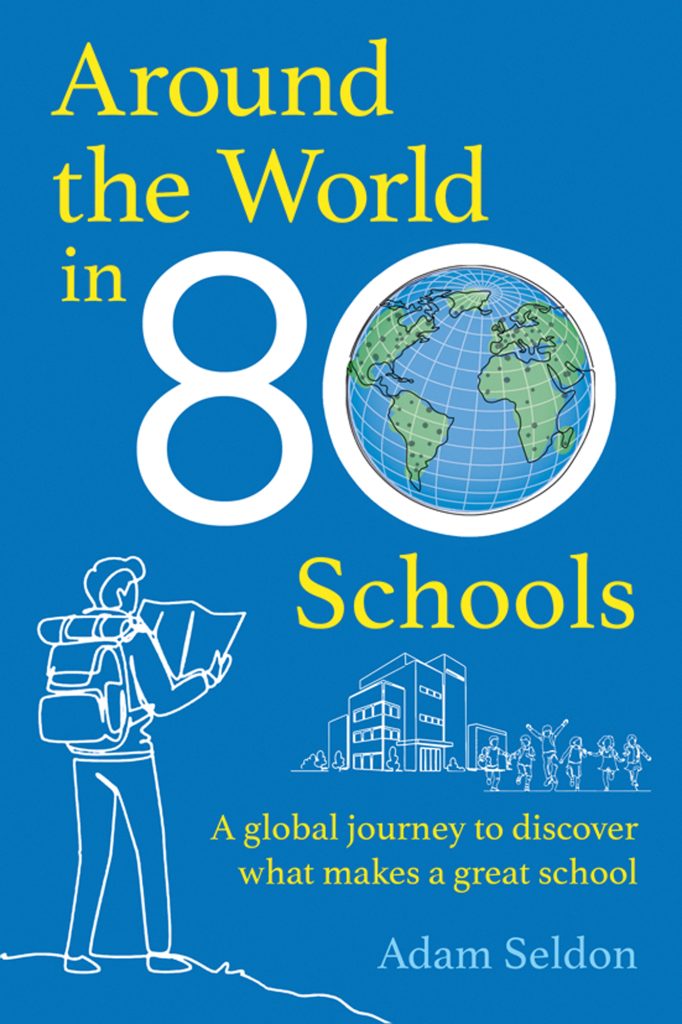
Adam Seldon is an Assistant Principal in the UK, who teaches History. A writer and podcaster, he is the author of Around the World in 80 Schools published by Crown House.
Click on the image to follow the link to Crown House
FEATURE IMAGE: by Sumanley xulx from Pixabay
Support Images: by Getty Images For Unsplash+ , ghariza mahavira For Unsplash+, Curated Lifestyle For Unsplash+ & Adriandra Karuniawan For Unsplash+
