
UNDERSTANDING WHAT IS REALLY THERE
Matthew Savage wonders what we might discover when we move away from the noisy thoroughfare of traditional schooling and assessment.
A trip to Kerala
For as long as I have known about the backwaters of Kerala, I have longed to go there myself. However, when I finally did, in January, I learned much more than I expected. About Kerala, sure, and its fluvial ecology; but also about seeing, and knowing.
When many of us think of a holiday in Kerala, we imagine staying and travelling on a traditional houseboat through its pristine, tranquil and labyrinthine waters. From The Hindu, in 2002, describing the kettuvallam as having “emerged as the mascot of Kerala Tourism”, to Kerala Tourism’s “Great Backwaters” campaign of 2013–14, this is no accident.
However, so commonplace have become these huge, polluting, noisy, lugging, tourist traps, that the whole experience can diverge quickly from the pastoral idyll we imagined. The larger waterways sometimes look more like a highway than a path, and, as a result, precious little wildlife braves the water, or the trees and banks on either side.
The ecological imprint is inarguable, and the evidence I found when researching this, damning. A 2025 government study by the Centre for Water Resources Development and Management set Vembanad Lake’s carrying capacity at 461 houseboats — yet 954 currently operate, discharging an estimated 23,016 litres of wastewater daily.
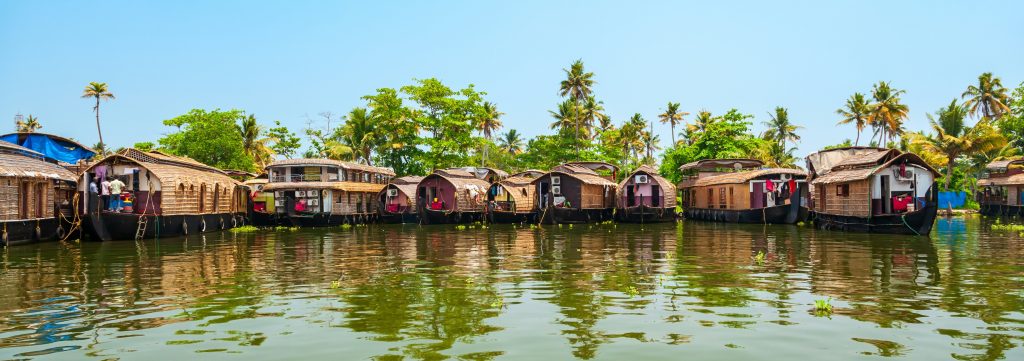
Fish species have dropped from 115 to 80, with catches falling 66% over three decades, and hundreds of thousands of migratory ducks that once congregated on the lake have disappeared due to disturbance from speedboats and houseboats.
A Kerala University study concluded that natural revival of the ecosystem may no longer be possible. If you want a deeper dive, try The Federal‘s October 2025 investigation “Why Vembanad’s houseboats have environmentalists worried” and Down to Earth‘s September 2025 long-read “Vembanad Lake may be scripting its own obituary.“
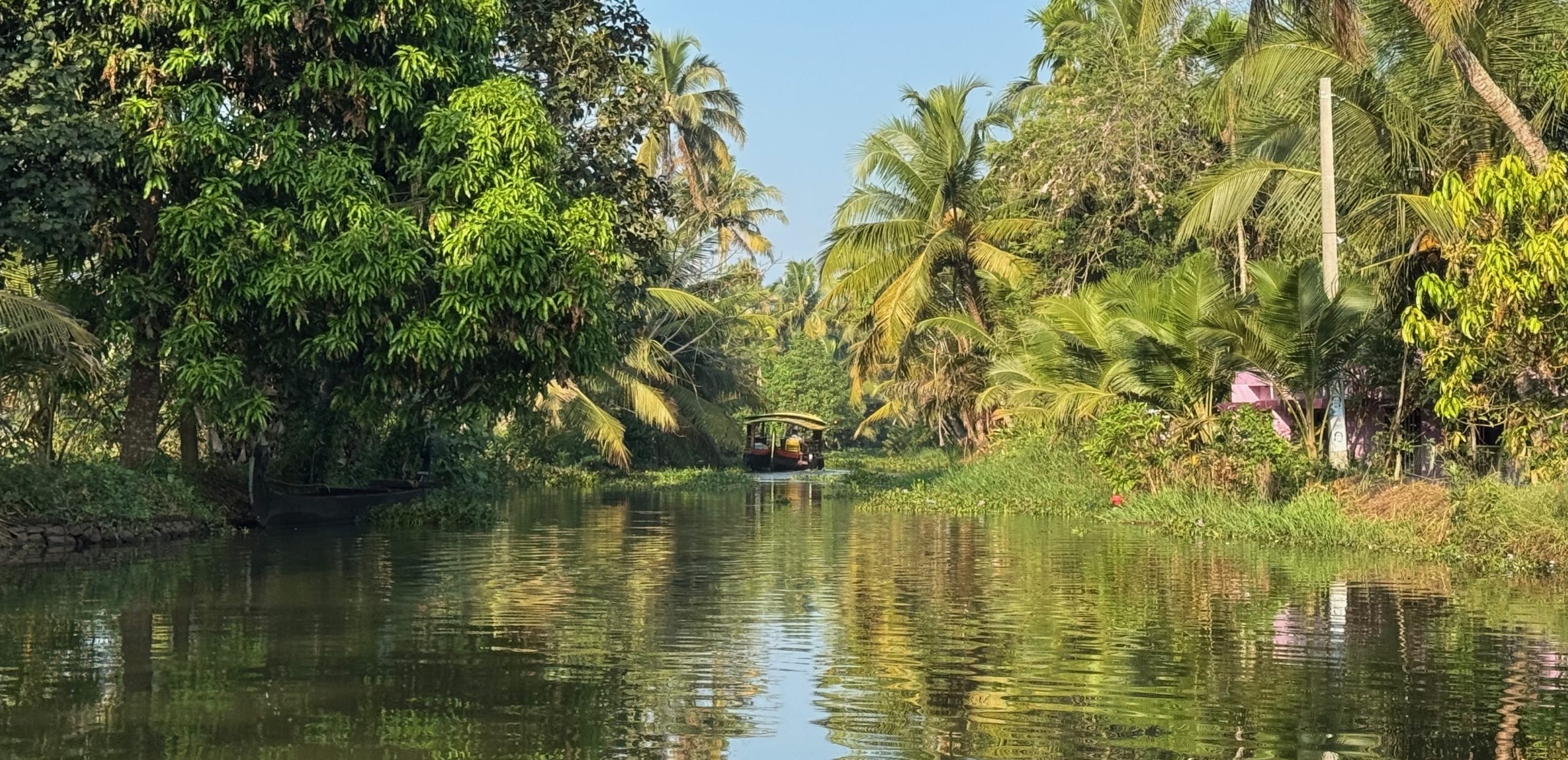
Where was the Kerala about which I was reading concurrently, in Verghese’s mythical The Covenant of Water? But then I was offered the chance to explore the backwaters at dawn in a 4-person, electric boat. This meant that we quickly deviated from the thoroughfares, diverting, instead, to the quietest, tiniest and greenest capillaries of this huge, arterial ecosystem.
At times, the plants’ green carpet threatened to obscure the water entirely (and that is another story altogether, starting with the British importation of the invasive Water Hyacinth), but we still wove our way through – the natural rhythms of the waterways unspoilt by our little craft – in ways no larger boat could have managed.
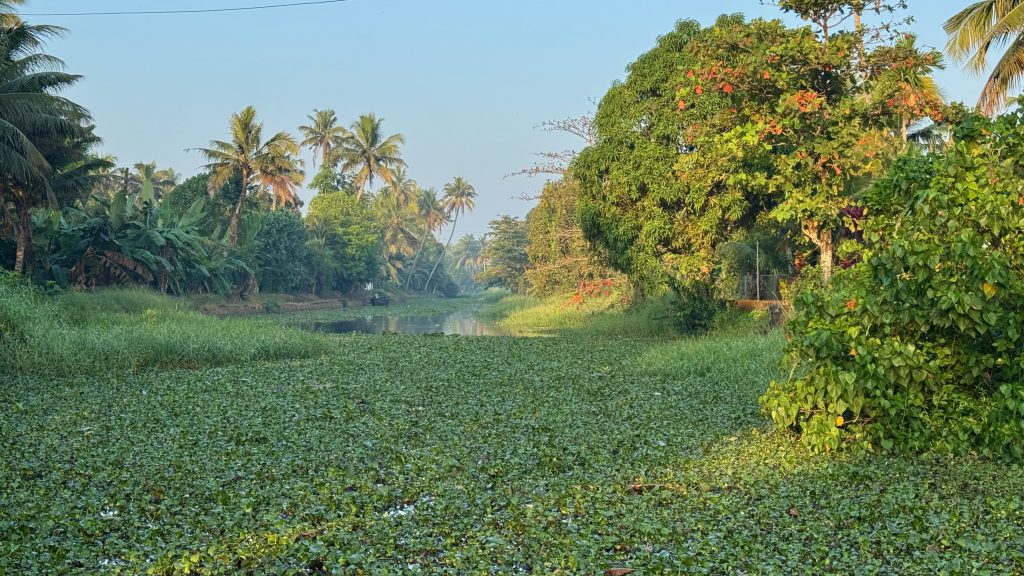
And all we could see – between river and sky – was flora and fauna, and all we could hear was the bubbling of the water through which we wended, the call of myriad birds, and the occasional shout or laughter from families living at the water’s edge.
We saw Kingfishers (White-breasted, Small Blue, and Pied) and Herons (Pond, Grey and Purple), Teals, Terns, Cormorants and Egrets, Black Bitterns and Brahminy Kites, and the ubiquitous Indian Darter (or snakebird). And we heard much more besides – such as the oop-oop-oop of the Greater Coucal.
Backwater thinking in schools
The contrast between ‘we saw nothing’ and ‘the water is alive’ has stayed with me – because I recognise it. So, too, in schools, the micro-lens of quiet and slow, attuned and intentional observation renders visible what the noisy, polluting paradigm of traditional assessment will never let us see.
If we rush and rumble relentlessly along the school highway, so much of what we want and need to see and know in our students will vanish, disturbed beyond sight by the wake we leave behind. If we want to tune into these critical frequencies, we need something simultaneously more and less than data; and, at once, bigger and smaller too: what I call Antidata.
Scientists estimate that only 5% of the universe is visible matter, with the other 95% either dark matter or dark energy. This is a sobering statistic, but what if the things we have always measured, and are still measuring today – the orthodoxy of assessment in schools – also captures only a small proportion of what is happening?
What of the student who is learning lots, but simply struggles to answer the questions on a test? What of the child who feels the cold lack of any sense of belonging, but responds to a survey with the answers they know their teacher would like to see? What of the teenager who is wrestling with trauma, or trying to withstand the microaggressions of identity-based harm, but we see only what we enter on the system as behaviour incidents?
Interspecies and indigenous epistemologies reject the hegemony of rational, empirical knowledge, and embrace, instead, a plurality of knowing. However, in schools, have we learned to ignore our gut, our senses, our intuit, in favour of what can be captured in a neat, quantifiable rubric?
Why do we insist that the immeasurable, unknowable messiness – of learning, wellbeing and belonging – can all be represented neatly and accurately on a dashboard or a report card, as if, like Chimamanda Adichie’s ‘single story’, they mean just that and nothing more?
Antidata offers us an alternative – a kind of relational epistemics. Noticing, listening, knowing through signals and on frequencies that cannot be shown on the colonial ledger. And in our tiny, electric vessel, as the sun rose over Kerala’s capillaries, I experienced its ecological equivalent. This ‘backwater seeing’ brought me light and warmth, deep understanding and pure joy – the very things we need most in schools today.
If you would like to learn more about Matthew’s work on Antidata, or the fresh paradigm of data and assessment he navigates with schools, please reach out to him at matthew@monalisaeffect.me.
FEATURE IMAGE: Thanks to Matthew.
Support Images: Thanks to Matthew & Getty Images For Unsplash+
