

RETHINKING LEADERSHIP FOR WOMEN TEACHERS
Dr. Denise Brohm looks at the gender imbalance in international school leadership and what might be done about it.
A continuing pattern
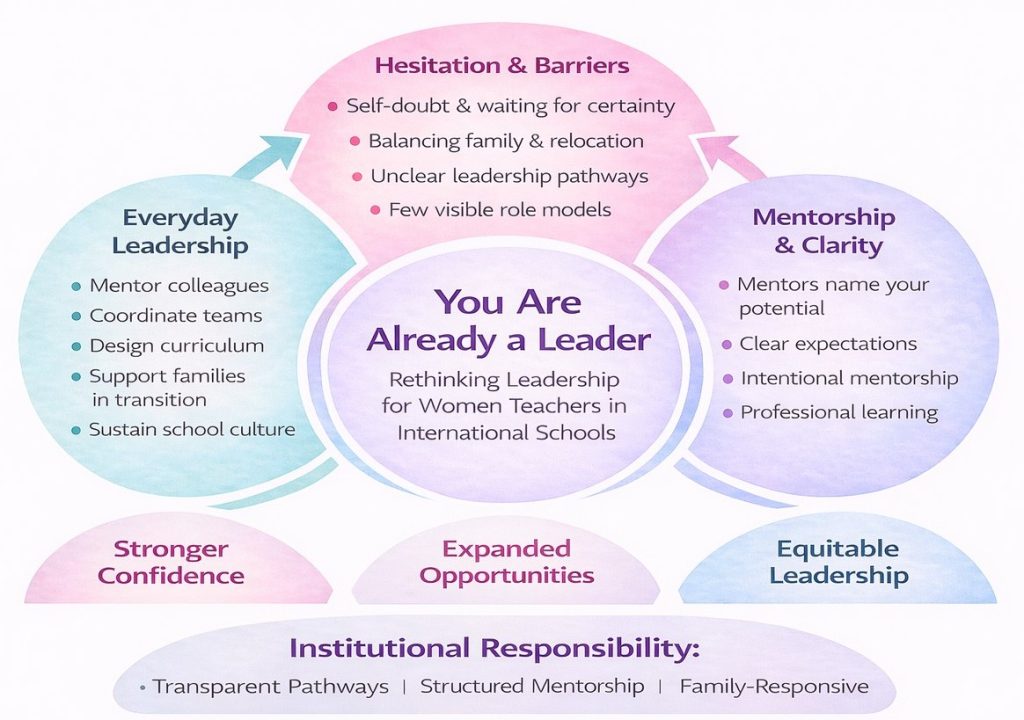
Many women in international schools lead every day without ever being formally recognized as leaders. They mentor new colleagues, coordinate teams, design curriculum and support families through transitions. They help steady communities during times of change and quietly sustain school culture. Yet much of this work happens without a title or public recognition. Over time, that invisibility can shape how women see themselves, as excellent teachers, certainly, but not necessarily as future leaders.
When formal leadership roles become available, hesitation often follows.
Over the years, it’s difficult to avoid noticing a pattern across international schools. Women made up the majority of classroom teachers, yet senior leadership roles were disproportionately held by men. This dynamic is not unique to one country or one system. It appeared across regions, including South Korea, where I later conducted research exploring how women navigate leadership pathways in international schools.

Seeing the leader within
As I listened to women describe their professional journeys, I heard something deeply familiar. Many had spent years refining their classroom practice and building strong student relationships. They were thoughtful, experienced educators who valued collaboration and community. Leadership, however, often felt like something that belonged to others, who seemed more assertive, more confident, or more naturally suited to administrative roles.
Even when encouraged to pursue leadership, many described questioning whether they were truly ready. They worried about timing, about balancing family responsibilities, and about whether their voices would be taken seriously. What stood out was not a lack of competence, but a pattern of waiting. Waiting for complete confidence, waiting for the “right” moment, waiting to feel fully prepared.
Certainty rarely arrives.
Timing and clarity
Leadership is not something we feel ready for immediately. It develops through experience, mentorship, and reflection. Many women later realized they had already been leading informally for years (mentoring colleagues, guiding curriculum initiatives, shaping school improvement) without recognizing that these experiences positioned them for formal roles. Waiting for certainty can quietly delay opportunity.
Clarity also matters. International schools vary widely in how leadership roles are defined and filled. In some contexts, pathways are transparent and structured. In others, advancement happens more informally. When expectations are unclear, hesitation grows. Teachers may wonder how to position themselves, what qualifications matter most, or whether leadership potential is being noticed.

Confidence and timing
Those who advance often described a turning point: someone naming their leadership potential directly. A mentor offering encouragement. A senior leader suggesting they apply. When expectations were made visible, confidence followed.
Balancing leadership with personal responsibilities was another consistent theme. International educators frequently navigate relocation, dual-career households, childcare across borders, and extended family commitments. Leadership roles can bring longer hours and greater emotional demands. For many women, the question was not “Can I do this?” but “Do I have time to sustain this?”
Without supportive policies or flexible structures, leadership can feel costly.
There is also the emotional complexity of leadership itself. Women leaders are often expected to be decisive and authoritative while remaining warm, collaborative and approachable. Navigating these layered expectations requires awareness and resilience. Several women described feeling especially conscious of how their communication might be interpreted or feeling pressure to demonstrate competence repeatedly. These dynamics are subtle, but they shape experience.
And yet, many women do step forward — and thrive.
Mentorship
Mentorship consistently emerged as one of the most important factors in leadership development. Women who had mentors were more likely to articulate career goals and pursue opportunities. Visible role models also mattered. When leadership looks diverse, it becomes easier to imagine oneself in those roles. Clear feedback and transparent expectations reduced uncertainty and encouraged action.
For women considering leadership, a few reflections may help. It is worth examining whether you are holding yourself to higher standards than the role requires. Leadership is developmental. Expressing interest creates possibility. Seeking mentorship intentionally strengthens confidence. Investing in professional learning builds capacity over time. Most importantly, leadership does not require abandoning relational strengths. Those strengths are often what make leadership effective.
Role models
Increasing women’s representation in leadership influences school culture and student experience. Diverse leadership teams strengthen decision-making and model equity for students. When girls see women in positions of authority, possibility expands. When boys observe equitable leadership, fairness becomes normalized.
International schools often describe themselves as globally minded institutions. Leadership diversity is part of that commitment.
Individual courage matters, but institutional responsibility is equally important. Schools can support women’s advancement through transparent hiring processes, structured mentorship, and family-responsive policies. When systems are clear and supportive, talent is more likely to step forward.

The leader in you
Every woman who considers leadership experiences moments of doubt. Doubt is not evidence of inadequacy; it is often a sign of growth. If you have ever contemplated stepping into leadership, that reflection itself signals capacity. Leadership may already be unfolding in your daily work, in the colleague you guide, the initiative you lead, the culture you help sustain.
For many women teachers, the next step is not about becoming someone new.
It is about recognizing the leader you already are.

Dr. Denise Brohm is a Grade 4 English teacher and team lead at Silicon Valley International School. She has over a decade of experience teaching in international schools and holds a Doctorate in Educational Leadership from the University of Southern California. Her work focuses on leadership, equity and supporting women in international schools. Denise is especially interested in creating inclusive, culturally responsive classrooms where both students and educators feel supported, confident and able to grow.
FEATURE IMAGE: by Getty Images For Unsplash+
Support Images and Graphic: Thank you to Denise, & Getty Images For Unsplash+
