

ACADEMIC PEER SUPPORT
At the International School of Tianjin students support each other’s learning across the curriculum in IST’s Literacy Lab. Joe Schaaf reports.
A Literacy Lab conversation
A student sits down with a science lab report reflecting on an experiment she has conducted. English is not her first language. She has burned chips and Cheetos to measure their calories, and she says the meaning of her reflection about what is happening is unclear to her. Amy, the coach across the table, is a student too. She asks whether the learner would like to read it aloud or have it read to her, then asks her to highlight any sentence she’s not certain about.
The learner reads. She stops at the ninth sentence, the one about her control variables. Amy asks why she highlighted it. The learner says it doesn’t connect to the rest of the reflection. Amy paraphrases: “So it doesn’t fit with the rest of your reflection?” Then she asks how the learner might change that. Maybe, the learner says, she could add a sentence about how the control variables affected the experiment. Amy suggests she go and do that now, then come back so they can compare the two versions. The whole conversation took under four minutes. Amy has not given a single word of advice, and she never will.

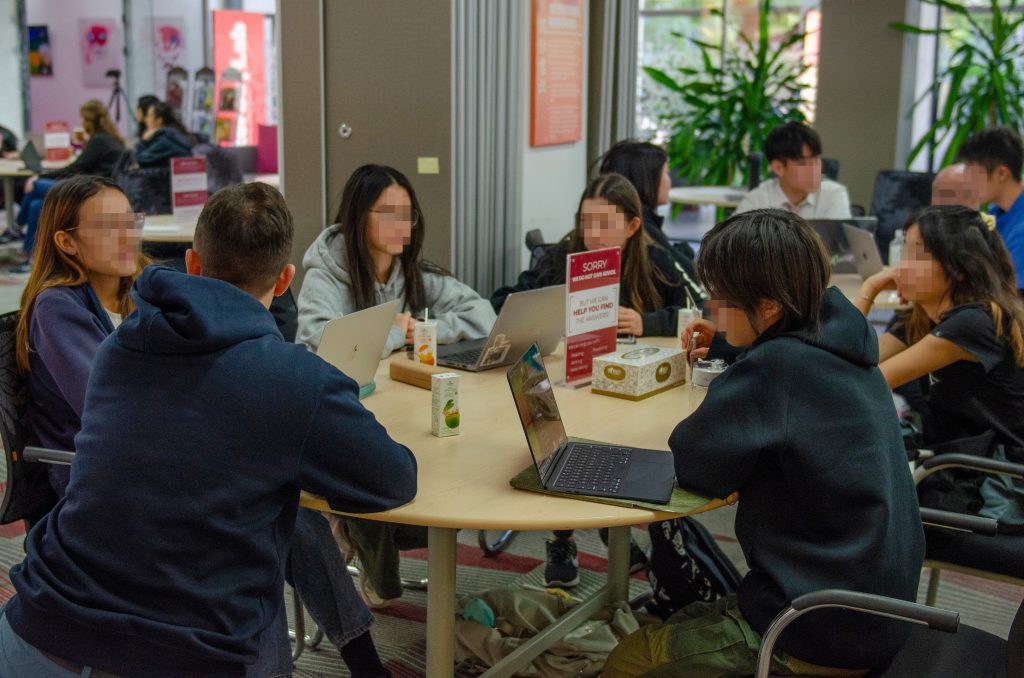
That is a typical conversation in the Literacy Lab, located in the library, on any given day of the week. The Lab has been providing support at the International School of Tianjin for more than a decade and is managed and staffed entirely by students. It records over 1,200 visits a year in a secondary school of just over 200 students. Learners come to the Lab for support with just about anything they do at school: essays, lab reports, presentations, discussions, readings they can’t get through, and some even come for help with friendships. No tutors. No advice. Just another student who listens thoughtfully and asks meaningful questions.
How it works
Every visit starts with a learner making a choice. Before any work is shared, the coach offers ten conferring strategies, sequenced from low risk to high. At one end is Listening, No Response: the learner reads aloud and the coach says nothing. At the other end is Evaluative Feedback, where the learner measures their work against the rubric. The learner picks how much challenge they’re ready for. Coaches will suggest a strategy when a learner isn’t sure, but the decision is always the learner’s. In the session described, the coach suggested Highlighting and the learner agreed.

The coach then works with three moves from Art Costa and Bob Garmston’s Cognitive Coaching:
- Pause after the learner speaks
- Paraphrase what was said
- Probe with a genuine question
‘Guide, don’t advise’
The principle behind all of it is ‘guide, don’t advise.’ Coaches never give advice. Instead, they help learners find the answers themselves. They coach the learner, not the task, and they keep the conversation concrete by focusing on what is on the page. Every session ends when the learner identifies the next step they need to take in their learning process.
None of our coaches are experts in a subject area. In fact, no expertise is needed. Anyone can coach. The only requirement is the ability to have a genuine conversation with another student and to use cognitive coaching reasonably well. The same coach who sat with the learner working on a lab report spent another session listening to a learner rehearse a geography presentation. The coach noted each time the learner raised her hand at a section she doubted, then used cognitive coaching to help her discover why she was uncertain. Coaching can even happen in whichever language the coach and learner share.
Student run
Students don’t just coach in the Lab, they run it. A tiered structure of coaches, supervisors and managers handles everything from staffing sessions to training new coaches. My job as faculty advisor is to protect the model and stay out of the way. One of the biggest mistakes schools make when adopting this model is letting it slip back into tutoring. Once adults decide coaching requires expertise, or start adding other constraints like a minimum GPA or a language proficiency level, they restrict who can volunteer, and the lab stops being student-run.
What students say
After every visit, learners rate the session anonymously. Across thousands of visits, the average is 4.75 out of five stars. We treat a learner’s emotions as part of the learning process. Last year we began asking two questions at the start of each session and again at the end: How clear are you about your work? How do you feel about it? Clarity rises nearly a full point on a five-point scale, and students who were unsure how they felt about their work leave feeling good about it. Just as important, the work stays theirs. As one learner, Mimi, put it: “They make sure that it’s your work and not the coach’s.”

Social outcomes
Students take more from the Lab than help with schoolwork. Momo, who went on to supervise the Lab, joined in Grade 8. What he didn’t expect was that it would help him outside school. “When I first joined, I was really shy,” he said two years later. “I’ve always had difficulty talking to people, especially small talk. Learning how to ask people probing questions out of genuine curiosity helped me a lot with this problem.”
Former coaches and Lab leaders say their Lab experience kept helping long after they left. The Lab led to leadership roles at school and helped with university applications, and it taught them how to present to a room, how to work with other people, and how to lead them. For some it has meant paid positions at college and jobs after it. Nearly all of them mention confidence.
(To hear it directly from them, watch the testimonials at literacylab.org.)

Joe Schaaf is Head of Learning and Teaching and Secondary Deputy Principal at the International School of Tianjin, and founder and faculty advisor of the IST Literacy Lab.
He can be reached at joe_schaaf@istianjin.org.cn.
Professional Development in Tianjin, October 17 – 18, 2026
A student-staffed and managed learning center that works.

As we enter our 14th year, we hope to continue sharing our model, so that more students, whether they come for support or come to coach, get what ours have had for over a decade. If your school is interested in establishing a student-run, student-staffed Literacy Lab, join us for a two-day workshop on October 17–18, where students and teachers train alongside our coaches and practice the model themselves. Registration is through ACAMIS and closes October 10. If you can’t make it, reach out to us. We are happy to come and share our experience with you.
The IST Literacy Lab model has been presented at ACAMIS and EARCOS conferences over the past five years and adopted by schools across China, Mongolia, Thailand, and Singapore. In 2024 the Lab received the ACAMIS Jim Koerschen Award for Innovation. A practitioner’s guide to building a student-run learning center is forthcoming from Routledge.
Feature & Support Images – Our thanks to the International School of Tianjin
