
On student reengagement in a disadvantaged town
Brad Maitland looks at the impact of alternative programmes at a small independent school in Australia on teenagers who have been written off.
A mandate to be different
Many schools across New South Wales in Australia are struggling with student numbers, student attendance and the ability to make learning relevant and fun. For a small independent school on the Mid-North Coast, set up primarily to get kids off the streets and re-engage them in education, the job of winning over jaded, street wise school refusers is hard.
Macleay Vocational College has a mandate to be different from its peers, an obligation to experiment with educational delivery that satisfies NESA (New South Wales Education Standards Authority) requirements while keeping learners engaged in a manner they didn’t experience in mainstream settings.

Kempsey
The College is located in the middle of Kempsey, a town with a history of economic problems and disadvantage. The town’s unemployment rate is significantly higher than the national average, as is its crime rate and the number of children living in families in which no member works. Household income in the town is almost half the national average. Kempsey is ranked as one of the poorest areas in NSW. It is in this environment that Macleay Vocational College works to deliver education and a future for their wards.
Our learners
Many of the student body also differ greatly from the common portrait of a typical school pupil. Our learners come to us with low literacy/numeracy rates, a distrust of authority figures, criminal histories, trauma, intergenerational welfare families, drug problems etc. Mainstream schools for the most part have failed them. Their experiences within the mainstream only served to reinforce negative stereotypes they held about the traditional education system. Many came away with feelings ranging from exclusion to alienation.

A last chance
It is at this critical junction that our school steps in as a last gasp measure, a final throw of the dice to try and entice marginalized students away from a path of crime, welfare and negativity that usually ends in incarceration. As a special assistance school, this is the space we operate within.
Given the limited resources available to the teaching team, several out of the box programs have been birthed, necessity being the mother of invention in our case.
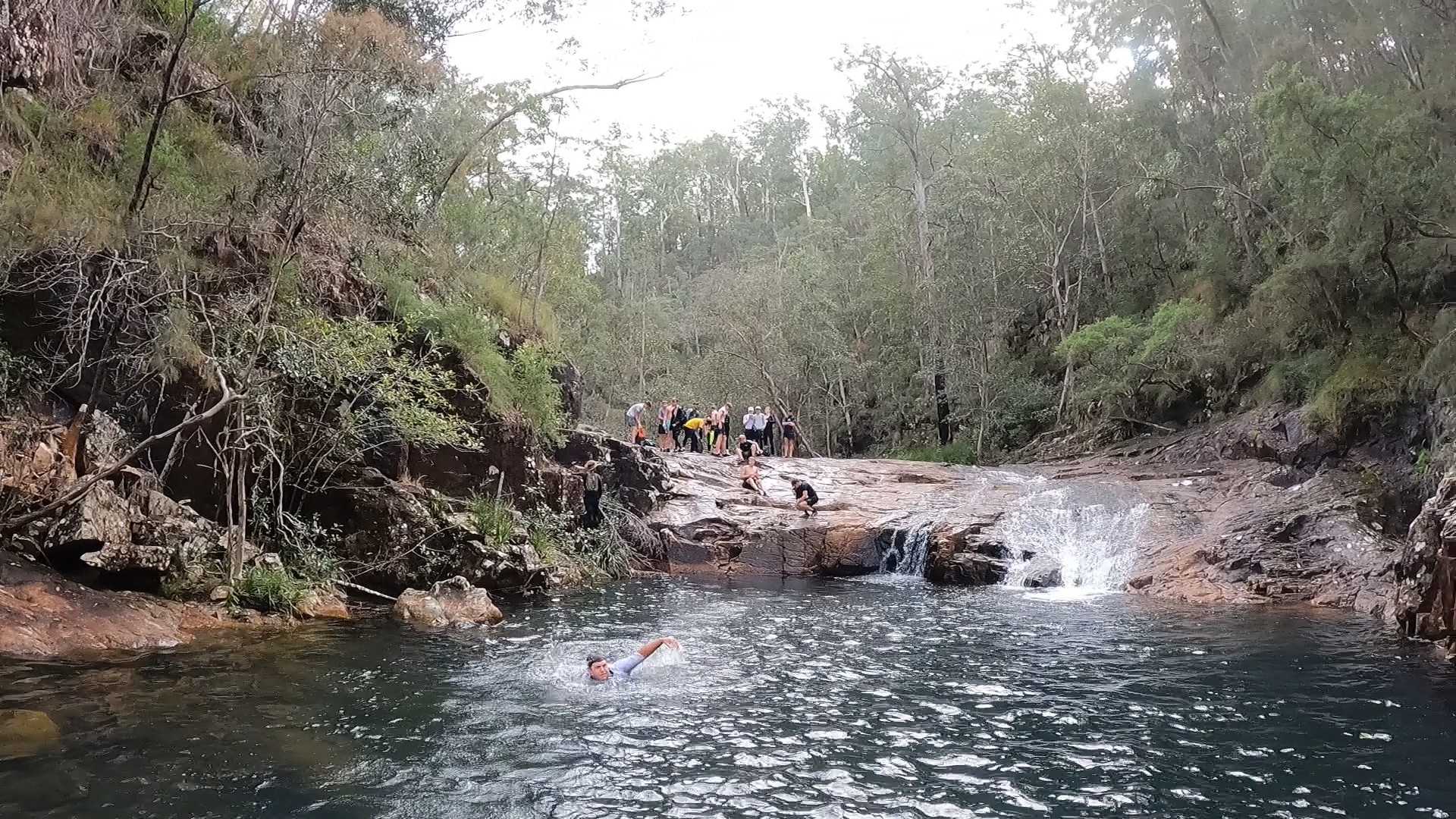
Extreme alternative: river trekking
One of the mainstay programs we offer to our learners is River Trekking. This activity takes place in the traditional country of the Dunghutti. (‘ The Djangadi people, also spelt Dhungatti, Dainggati, Tunggutti or Dunghutti are an Aboriginal Australian people resident in the Macleay Valley of northern New South Wales.’ – Wikipedia )

This is an outdoor activity that combines swimming along stretches of river and creek, snorkelling, rock climbing, navigation, and plotting courses through unfamiliar terrain with the aim of reaching a hidden waterfall far outside of the public purview. Such waterfalls are only available to those seekers willing to challenge themselves enough to experience areas which most of the public will never witness.
Impact
For our students, many of whom struggle with significant problems in their personal lives, river trekking removes them from the urban environment and immerses them in nature, placing them back into traditional country. It is within the deep forests that for our students the healing process begins. The health benefits from time spent river trekking are legion. Lower stress levels, mood enhancement, boosting the immune system, lowering blood pressure, improved sleep quality and increased energy levels. A long trek allows our students to bond with one another and form lasting friendships with the accompanying teachers and Elders. These relationships translate directly into the classroom and result in respect, understanding, cooperation and better outcomes for both teachers and students.
All participants on these excursions must use teamwork to overcome physical barriers and arduous terrain. They discover that no objects placed in their paths are insurmountable. The parallels with life outside school are not lost on our young men and women.

Planning
The logistics for the excursions are plotted out on Google earth. My team and I identify hidden waterfalls in the heart of Dunghutti country and then spend several weekends exploring the river/creek system, plotting out entry and exit points, identifying grades of obstacles, weak and strong points and alternate paths.
These excursions focus on the Forbes, Wilson and Hastings River systems and surrounding hinterlands. Often on these freshwater adventures they will encounter a number of species unique to the local environment including Australian bass, long finned eels, turtles, platypus, bullrouts, freshwater catfish and crayfish.
Indigenous links and 8 ways of learning
While doing these trekking tours students also get the opportunity to deepen their learning about Indigenous links to the land, traditional freshwater hunting methods, wildlife migration and breeding patterns, hunting and cooking methods, traditional Aboriginal homelands, the use of certain barks and plant toxins to fish, netting methods, fish traps and the Indigenous spiritual link to the land.
As we trek on country, students incorporate this related knowledge, absorbing the lessons of the elders who work with us at our school. There is a sustained focus on imparting knowledge about bush medicines and foods that grow in abundance along the isolated river systems through which we trek. Students are shown how to identify edible fruits and seeds of the lily pilly, sandpaper fig, native grape and lolly bushes.

Trekking incorporates the Aboriginal 8 ways of learning, delivering in real time Community Links, Land Links, Symbols, Images, Learning Maps, Traditional Knowledge, Aboriginal Perspectives and Aboriginal Processes. These forays into the wilderness intertwine both Aboriginal and non-Indigenous pedagogies to create the best outcomes for our students possible. Aboriginal Studies, History, Marine Studies, Geography, SLR, Sport and VET subjects link into such forays.
Outcomes
By trekking through traditional country, drawing on traditional Indigenous knowledge and combining this with contemporary education, the College is successfully challenging students to overcome surmountable life obstacles while helping them reengage with education, learn culture, respect themselves and forge a new route which features them walking a positive path into the workforce and beyond.

Brad Maitland teaches Marine Studies and History at MVC. He has worked with At-Risk youth for the last 15 years and lives in Port Macquarie, Australia.
Feature Image: A group swimming downriver from fall to fall
All images kindly provided by Brad with the permission of Macleay Vocational College, Kempsey.
